Is Using a Standing Desk Better for Your Health Than Sitting All Day?
Last updated: 27 Aug 2026
You have read that sitting all day is damaging your health. You are considering buying a standing desk. Before you spend several hundred dollars, it is worth understanding what standing desks actually do for your health, what they do not do, and whether the investment is justified by the evidence.
The short answer: standing desks are better than sitting all day, but they are not the solution most people think they are. And they are certainly not a substitute for actual movement.
Find out if sedentary lifestyle is affecting your health
Patient-first, Holistic, Dedicated Healthcare
What the Evidence Says Standing Desks Do
Research on standing desks has produced consistent findings in a few areas.
- They reduce total sitting time - This is the most reliably demonstrated benefit. Workers with sit-stand desks reduce their daily sitting time by approximately 30 to 120 minutes compared to those with conventional desks. Given that the metabolic consequences of sitting begin within hours of sustained inactivity, any reduction in unbroken sitting has value.
- They modestly improve blood sugar after meals - A small number of studies have found that standing after eating produces lower post-meal blood sugar spikes compared to sitting. For anyone managing prediabetes or insulin resistance, this is a meaningful benefit, though walking after meals is even more effective.
- They reduce self-reported back and neck discomfort - Many office workers report reduced lower back pain and neck stiffness when alternating between sitting and standing. This is likely related to posture variation rather than standing itself. Holding any single position for hours, whether sitting or standing, creates musculoskeletal strain. Alternating between the two distributes the load more evenly.
- They improve subjective energy and mood - Several workplace studies have found that employees using sit-stand desks report feeling more energetic and less fatigued during the afternoon compared to seated colleagues. This effect is modest but consistent.
What Standing Desks Do Not Do
This is where the marketing outpaces the science.
- They do not significantly increase calorie expenditure - Standing burns approximately 0.15 calories per minute more than sitting. Over an hour, that is roughly 9 extra calories. Over an eight-hour workday, standing for half the time burns approximately 36 additional calories compared to sitting all day. That is less than a single digestive biscuit. If your primary reason for considering a standing desk is weight loss, the contribution is negligible.
- They do not replace exercise - Standing is not physical activity. Your muscles are engaged at a very low level to maintain an upright posture, but your heart rate does not meaningfully increase, your muscles are not being challenged, and the metabolic stimulus is minimal compared to actual movement. Standing for three hours provides nowhere near the cardiovascular, metabolic, or muscular benefits of a 30-minute brisk walk.
- They do not eliminate the risks of prolonged static posture - Prolonged standing carries its own health risks. Varicose veins, lower limb swelling, foot pain, and lower back discomfort are all associated with extended standing without movement. Workers who stand for their entire shift (retail, hospitality, manufacturing) experience musculoskeletal problems at rates comparable to those who sit all day. The problem is not sitting or standing specifically. It is immobility.
- They do not meaningfully reduce cardiovascular risk on their own - The metabolic benefits of standing desks, while real, are too modest in isolation to significantly alter cardiovascular risk profiles. A standing desk does not lower your cholesterol or reduce your blood pressure in a clinically significant way. It needs to be combined with regular movement and exercise to contribute to cardiovascular health.
The Real Issue: Static Posture, Not Sitting vs Standing
The research increasingly suggests that the core problem with modern office work is not sitting itself. It is prolonged, unbroken static posture, whether sitting or standing.
Your body is designed for movement. When you hold any position for extended periods, blood pools in your lower extremities, metabolic processes slow, muscle activity drops to near zero, and the musculoskeletal system begins to stiffen. Switching from a static sitting position to a static standing position addresses part of this but misses the fundamental issue: your body needs to move.
This is why research consistently shows that brief, frequent movement breaks throughout the day produce greater health benefits than simply standing instead of sitting. Getting up and walking for two to three minutes every 30 to 60 minutes interrupts the metabolic shutdown that occurs during sustained sitting more effectively than standing in place does.
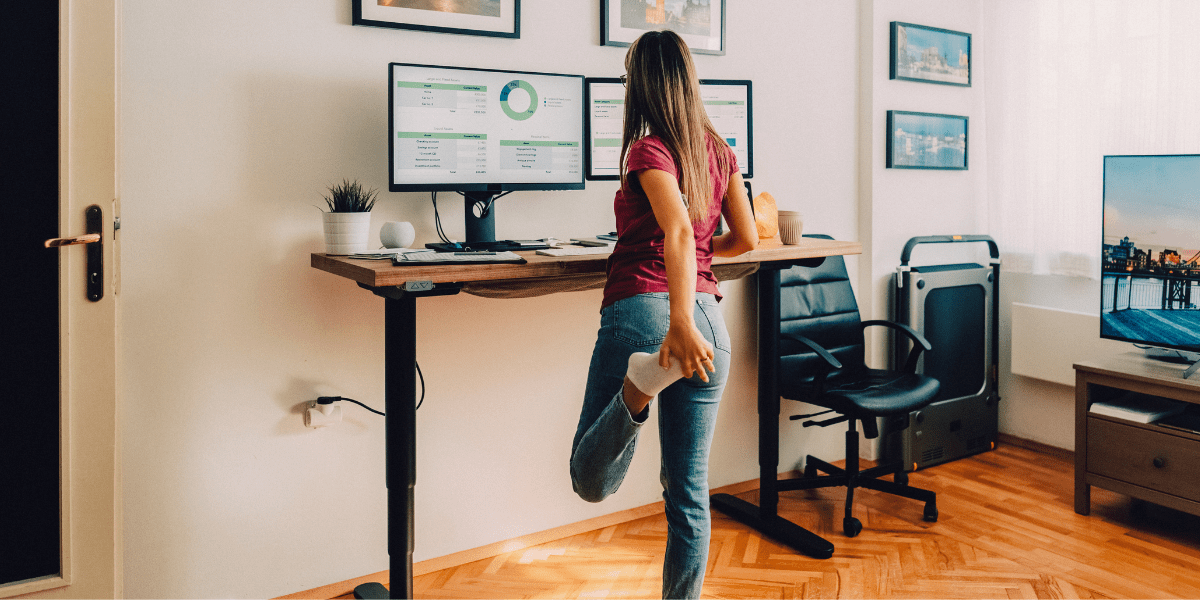
The ideal office setup is not a sitting desk or a standing desk. It is a desk that allows you to alternate between sitting and standing, combined with regular movement breaks that get you walking, stretching, or climbing stairs throughout the day.
Practical Guidance: If You Buy One
If you decide a sit-stand desk is worth the investment, here is how to use it for maximum benefit.
- Alternate, do not stand all day - The consensus recommendation is to begin with 20 to 30 minutes of standing per hour and increase gradually. Most experts suggest a ratio of roughly 1:1 to 2:1 sitting to standing. Standing for your entire workday trades one set of problems for another.
- Wear supportive footwear - Standing at a desk in socks or unsupportive shoes for hours will produce foot, knee, and lower back discomfort. A cushioned anti-fatigue mat helps if you stand frequently.
- Shift your weight and move while standing - Do not stand rigidly. Shift your weight from foot to foot, sway slightly, take a step sideways. Even minimal fidgeting while standing increases muscle engagement and blood flow compared to standing still.
- Still take movement breaks - A standing desk does not replace the need to walk away from your desk regularly. The two to three minute walk every 30 to 60 minutes remains the single most effective office-based health intervention, regardless of whether you are sitting or standing when the reminder goes off.
- Pair it with a post-meal walk - As we covered in our blog on hawker food and blood sugar, walking for 10 to 15 minutes after eating reduces post-meal glucose spikes more effectively than either sitting or standing.
What Matters More Than Your Desk
Your desk setup is one variable in a much larger equation. The factors that have a far greater impact on the metabolic risks associated with office work include:
- Your total daily step count (aim for 7,000 to 10,000)
- Whether you break up sitting with movement every 30 to 60 minutes
- Whether you walk after meals
- How much structured exercise you do outside of work (the WHO recommends 150 minutes of moderate activity per week plus resistance training),
- Your VO2 max (a stronger predictor of mortality than any desk configuration),
- Your overall metabolic health (blood sugar, cholesterol, blood pressure, waist circumference).
If you are sitting 10 hours a day, exercising zero times per week, and considering a standing desk as your primary health intervention, you are optimising the wrong variable. The standing desk might contribute 5 per cent of the solution. The other 95 per cent is movement, exercise, diet, and sleep.
A health screening tells you whether your current lifestyle has already affected your metabolic markers. A conversation at our GP clinic can help you build a realistic plan that addresses the factors that actually move the needle, with or without a standing desk.
Find out if sedentary lifestyle is affecting your health
Patient-first, Holistic, Dedicated Healthcare
Medical Disclaimer & Limitation of Liability
The content provided in this post is strictly for informational and educational purposes. Just as we fiercely defend our right to publish general health information, we establish an uncompromising boundary: this material is never a substitute for personalised, professional medical advice, diagnosis, or treatment.
Reading this content does not establish a doctor-patient relationship. You possess the sovereign right and responsibility to manage your own health, which means you must consult your own qualified physician before making any medical decisions based on what you read here. We explicitly disclaim all medicolegal liability for any injury, loss, or risk incurred directly or indirectly from the misinterpretation, misuse, or out-of-context application of our online content. Your health is your responsibility; seek individual professional care.