VO2 Max: The Fitness Metric That Predicts How Long You Will Live
Last updated: 25 Aug 2026
If you have ever been told that your BMI is the best indicator of your health, the evidence now says otherwise.
In 2018, researchers at the Cleveland Clinic published one of the largest studies ever conducted on fitness and mortality. They tracked 122,007 adults over more than a decade and measured one variable: cardiorespiratory fitness, quantified as VO2 max. The finding was unambiguous. VO2 max was the single most powerful predictor of survival. More powerful than BMI. More powerful than smoking status. More powerful than high blood pressure, high cholesterol, or existing heart disease.
People in the lowest fitness category had nearly five times the mortality risk of those in the highest. And the benefit had no upper limit. Every improvement in fitness, at every level, was associated with longer life.
In 2022, a study of over 750,000 U.S. veterans confirmed the finding. Each 1-MET increase in fitness (approximately 3.5 ml/kg/min of VO2 max) was associated with a 13 to 15 per cent reduction in mortality risk, regardless of age, BMI, sex, or existing conditions.
In 2025, a systematic review and meta-analysis of nearly 400,000 individuals went further. It found that fit individuals who were overweight or obese had no statistically significant increase in mortality risk compared to fit individuals of normal weight. Unfit individuals, regardless of weight, had two to three times higher mortality risk.
The implication is profound: being fit and overweight is significantly safer than being thin and unfit. BMI, on its own, tells you very little about how long you will live. VO2 max tells you far more.
Find out more about your health
Patient-first, Holistic, Dedicated Healthcare
What VO2 Max Actually Measures
VO2 max stands for maximal oxygen uptake. It measures the maximum amount of oxygen your body can absorb and use during intense exercise, expressed in millilitres of oxygen per kilogram of body weight per minute (ml/kg/min).
When you exercise, your muscles need oxygen to produce energy. The harder you work, the more oxygen your muscles demand. At some point, your cardiovascular system reaches its limit. Your heart, lungs, and blood vessels are delivering oxygen as fast as they can, but your muscles are demanding more. That ceiling is your VO2 max.
A higher VO2 max means your cardiovascular system is more efficient at delivering oxygen to working muscles. It reflects the combined function of your heart (how much blood it pumps per beat), your lungs (how effectively they transfer oxygen to your blood), your blood vessels (how well they distribute blood to working muscles), and your muscles (how efficiently they extract and use oxygen).
VO2 max is not just a fitness metric. It is a measure of how well your entire cardiovascular system works. This is why it predicts mortality so powerfully. A strong cardiovascular system protects against heart disease, stroke, diabetes, cognitive decline, and a wide range of chronic conditions. A weak one accelerates all of them.
Why BMI Falls Short
BMI is calculated by dividing your weight in kilograms by the square of your height in metres. It was designed in the 1830s as a population-level statistical tool, not as an individual health assessment. And it has significant limitations.
BMI does not distinguish between muscle and fat. A muscular person with low body fat can have the same BMI as a sedentary person carrying significant visceral fat. BMI does not tell you where your fat is stored. Abdominal visceral fat is metabolically dangerous, while subcutaneous fat on the hips and thighs carries much less risk. Two people with identical BMIs can have vastly different metabolic health profiles.
BMI also does not account for fitness. As the 2025 meta-analysis demonstrated, a fit person with a BMI of 30 (classified as obese) has similar mortality risk to a fit person with a BMI of 23 (classified as normal weight). An unfit person with a BMI of 23, however, faces substantially higher risk than either.
This does not mean BMI is useless. At the population level, higher BMI does correlate with higher disease prevalence. But for an individual assessment of health and longevity, VO2 max provides a far more meaningful picture. The American Heart Association has proposed that cardiorespiratory fitness be assessed as a clinical vital sign, alongside blood pressure, heart rate, and temperature, precisely because of its predictive power.
What Is a Good VO2 Max?
VO2 max varies by age and sex. It declines naturally with age, typically by about 10 per cent per decade after age 30 in sedentary individuals. However, regular exercise significantly slows this decline.
General reference ranges for adults (ml/kg/min):
- Men aged 30 to 39: Below average is under 35. Average is 35 to 40. Good is 40 to 48. Excellent is above 48.
- Women aged 30 to 39: Below average is under 28. Average is 28 to 34. Good is 34 to 41. Excellent is above 41.
- Men aged 50 to 59: Below average is under 27. Average is 27 to 35. Good is 35 to 43. Excellent is above 43.
- Women aged 50 to 59: Below average is under 22. Average is 22 to 28. Good is 28 to 37. Excellent is above 37.
These ranges are approximate. What matters most is not your absolute number but your position relative to your age and sex peers, and whether it is improving, stable, or declining over time.
The Copenhagen Male Study, which followed 5,107 men for 46 years, found that men in the highest cardiorespiratory fitness category lived approximately five years longer than those in the lowest category, after adjusting for other risk factors. Five years of additional life, attributable to fitness alone.
How to Measure Your VO2 Max
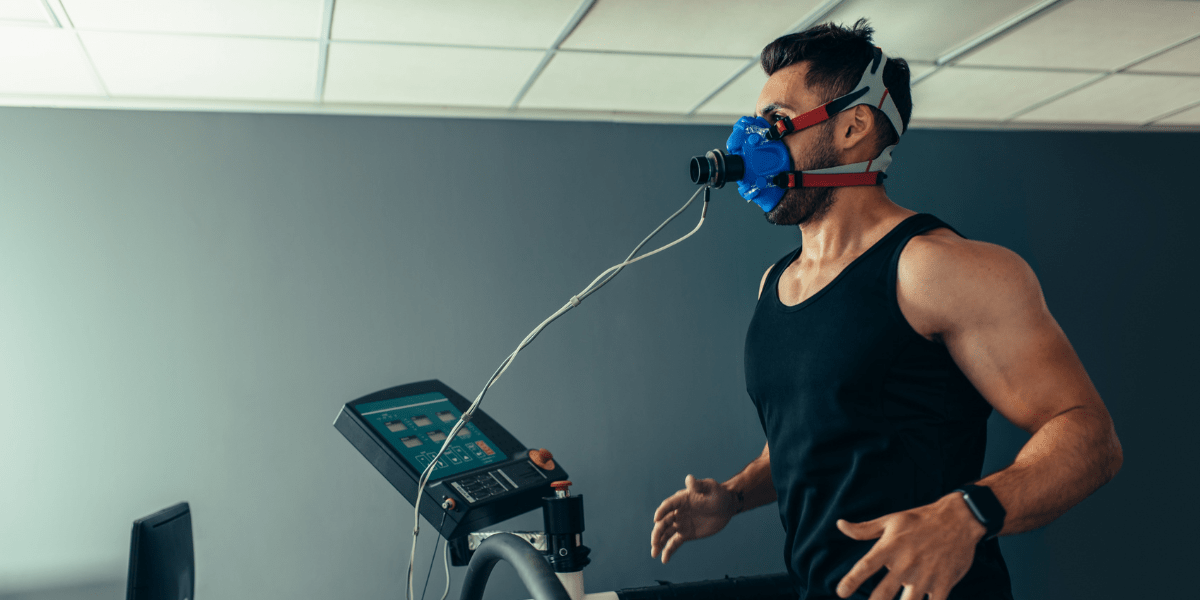
The gold standard for VO2 max measurement is a cardiopulmonary exercise test (CPET), performed in a clinical or sports medicine setting. You exercise on a treadmill or stationary bike at progressively increasing intensity while wearing a mask that measures your oxygen consumption and carbon dioxide production in real time. The test continues until you reach exhaustion. This provides a precise, laboratory-grade VO2 max measurement.
However, clinical CPET is expensive, resource-intensive, and not routinely available in primary care settings. For most people, there are practical alternatives.
- Smartwatch estimates - Apple Watch, Garmin, and other wearable devices estimate VO2 max using heart rate data and movement patterns. A 2025 validation study found that Apple Watch estimates have reasonable accuracy at the group level but meaningful individual-level error. They are useful for tracking trends over time (is your fitness improving or declining?) but should not be treated as precise clinical measurements.
- Submaximal fitness tests - The Cooper 12-minute run test, the Rockport walking test, and the beep test all provide VO2 max estimates based on performance. These can be done at any park or running track in Singapore and give a reasonable approximation.
- Clinical estimation from exercise tolerance - Your doctor can estimate your fitness level from your exercise habits and tolerance. Being able to climb four flights of stairs without stopping, or walk briskly for 30 minutes without breathlessness, correlates with reasonable cardiorespiratory fitness.
How to Improve Your VO2 Max
The most effective way to improve VO2 max is through regular aerobic exercise at moderate to high intensity.
As we discussed in our guide to exercise intensity and health, HIIT produces the fastest VO2 max improvements per unit of time. Two to three sessions per week of 20 to 30 minutes of interval training (alternating between high-effort and recovery periods) can meaningfully improve VO2 max within 6 to 12 weeks.
However, consistent moderate-intensity exercise also improves VO2 max. Regular brisk walking, cycling, swimming, or jogging at a pace that elevates your heart rate to 60 to 80 per cent of your maximum will produce gradual but sustained improvements.
The key insight from the mortality data is that the biggest gains come from moving out of the bottom fitness quartile. If you are currently sedentary, starting a walking programme and gradually adding intensity will produce the most dramatic reduction in mortality risk. You do not need to achieve elite VO2 max to benefit. You need to not be in the lowest category.
Resistance training does not directly improve VO2 max but supports it indirectly by preserving muscle mass, maintaining metabolic health, and enabling you to continue aerobic training as you age. The combination of aerobic and resistance training remains the evidence-based recommendation for longevity.
VO2 Max Is Modifiable. That Is the Point.
Unlike your age, your genetics, or your family history, VO2 max is something you can change. It responds to training at any age. Studies have demonstrated meaningful improvements in VO2 max in adults in their 60s, 70s, and even 80s who begin regular exercise programmes.
This is what makes it such a powerful health metric. It is not just a predictor of mortality. It is a modifiable predictor of mortality. Improving your VO2 max directly reduces your risk of dying from cardiovascular disease, diabetes, cancer, and all causes combined.
If you are interested in understanding where your cardiovascular fitness stands, start with an honest assessment of your current activity level. A health screening at Regis Medical provides the metabolic context (blood pressure, blood sugar, cholesterol, kidney function) alongside which a fitness assessment becomes far more meaningful. Knowing your numbers, both metabolic and cardiovascular, gives you the complete picture.
Your BMI tells you what you weigh relative to your height. Your VO2 max tells you how well your body actually works. One of those matters far more for how long you will live.
Find out more about your health
Patient-first, Holistic, Dedicated Healthcare
Medical Disclaimer & Limitation of Liability
The content provided in this post is strictly for informational and educational purposes. Just as we fiercely defend our right to publish general health information, we establish an uncompromising boundary: this material is never a substitute for personalised, professional medical advice, diagnosis, or treatment.
Reading this content does not establish a doctor-patient relationship. You possess the sovereign right and responsibility to manage your own health, which means you must consult your own qualified physician before making any medical decisions based on what you read here. We explicitly disclaim all medicolegal liability for any injury, loss, or risk incurred directly or indirectly from the misinterpretation, misuse, or out-of-context application of our online content. Your health is your responsibility; seek individual professional care.