Typhoid vs Food Poisoning: How to Tell the Difference When Travelling
Last updated: 27 Aug 2026

You're three days into a trip. You start feeling off. Stomach cramps, maybe some nausea, a general sense of being unwell. Your first thought is predictable: bad street food, dodgy water, nothing a couple of days' rest won't fix.
Most of the time, that assumption is correct. Traveller's diarrhoea and mild food poisoning are extremely common and usually resolve on their own within 48 to 72 hours.
But occasionally, what feels like food poisoning is actually the early stage of typhoid fever. And typhoid is not something that resolves on its own. It is a systemic bacterial infection that enters your bloodstream, spreads to multiple organs, and can become life-threatening if left untreated. The problem is that the early symptoms of both conditions overlap significantly, which means typhoid often gets dismissed during the exact window when treatment would be most effective.
Vaccinate against typhoid fever when you travel
Patient-first, Holistic, Dedicated Healthcare
They Start the Same Way. They Don't End the Same Way.
Food poisoning, in most cases, is caused by toxins produced by bacteria like Staphylococcus aureus or Bacillus cereus, or by common Salmonella strains found in contaminated food. The onset is usually rapid. You eat something contaminated, and within a few hours you experience nausea, vomiting, diarrhoea, and stomach cramps. It is unpleasant, sometimes severely so, but the body clears the toxins relatively quickly. Most episodes peak within 24 hours and resolve within two to three days without medical intervention.
Typhoid fever is caused by a specific bacterium called Salmonella enterica serotype Typhi. It belongs to the same family of bacteria that causes common food poisoning, but it behaves entirely differently. Instead of staying in the gut and causing localised symptoms, S. Typhi crosses the intestinal wall, enters the bloodstream, and spreads throughout the body. This is why typhoid is classified as a systemic infection rather than a gastrointestinal illness.
The incubation period for typhoid is also much longer. While food poisoning typically appears within hours of eating contaminated food, typhoid symptoms usually develop 10 to 20 days after ingestion. This delay means you might not even connect your symptoms to something you ate nearly two weeks ago. You might even be back home in Singapore before symptoms appear.
The Signs That Separate Typhoid from Food Poisoning
The early symptoms of typhoid can mimic a stomach bug or a mild flu. But as the illness progresses, clear differences emerge.
With food poisoning, vomiting and diarrhoea are usually the dominant symptoms. They come on suddenly, peak quickly, and taper off. Fever, if it occurs at all, is typically low grade and short-lived. Once the body expels the contaminated food, you start feeling better.
With typhoid, the pattern is different. The hallmark symptom is a fever that starts low and climbs steadily over several days, sometimes reaching 39 to 40 degrees Celsius. This "stepladder" fever is characteristic of typhoid and is rarely seen in food poisoning. It persists and does not respond to simple rest.
Other distinguishing signs include a sustained headache that worsens over time, profound fatigue and weakness that feels disproportionate to what you would expect from a stomach bug, abdominal pain that tends to be more diffuse than the cramping seen in food poisoning, and, counterintuitively, constipation rather than diarrhoea in the early stages. Some patients develop faint pink spots on the chest or abdomen, known as "rose spots," though these can be difficult to see on darker skin tones.
The key difference is trajectory. Food poisoning gets worse quickly and then gets better. Typhoid gets worse slowly and continues to deteriorate. If your symptoms are not improving after three to four days, or if a fever keeps climbing despite rest and hydration, you should not assume you are dealing with a bad meal.
Why This Matters for Singaporean Travelling Abroad
Typhoid fever is rare in Singapore due to our high standards of water treatment and sanitation. But it remains common in South Asia, Southeast Asia, Africa, and parts of South America. These are precisely the regions Singaporeans travel to frequently, whether for holidays, visiting family, or business.
The Indian subcontinent carries the highest risk. Studies consistently show that the majority of travel-associated typhoid cases in developed countries originate from trips to India, Pakistan, Bangladesh, Nepal, and Sri Lanka. But risk is not limited to these areas. Eating from street vendors, drinking untreated water, consuming raw vegetables washed in contaminated water, or eating shellfish from polluted sources can expose you to S. Typhi anywhere sanitation is inconsistent.
The danger for Singaporean travellers is specifically the assumption that stomach problems abroad are always food poisoning. Because we rarely encounter typhoid at home, it does not occur to most people as a possibility. This means typhoid often goes undiagnosed until symptoms become severe, at which point treatment is more complicated and the risk of serious complications increases.
Untreated typhoid can cause intestinal perforation, internal bleeding, and organ damage. It has a fatality rate of up to 10 to 30 percent when untreated. With appropriate antibiotics, that drops to less than 1 percent. The difference between those two numbers is early recognition and timely medical attention.
What to Do If You Suspect Typhoid
If you develop a persistent fever that climbs over several days during or after travel to a high-risk area, see a doctor. Do not wait for it to pass. Tell the doctor where you have been travelling and what you ate. Typhoid is diagnosed through blood cultures and can be treated effectively with antibiotics when caught early.
If you are still abroad, seek medical care locally. If you have returned to Singapore and symptoms develop in the days or weeks after your trip, visit a GP clinic and mention your recent travel history. This context is critical for accurate diagnosis. Our Doctors at Regis Medical routinely assess patients returning from travel and are experienced in recognising the signs that distinguish typhoid from routine traveller's illness.
Prevention Before You Travel
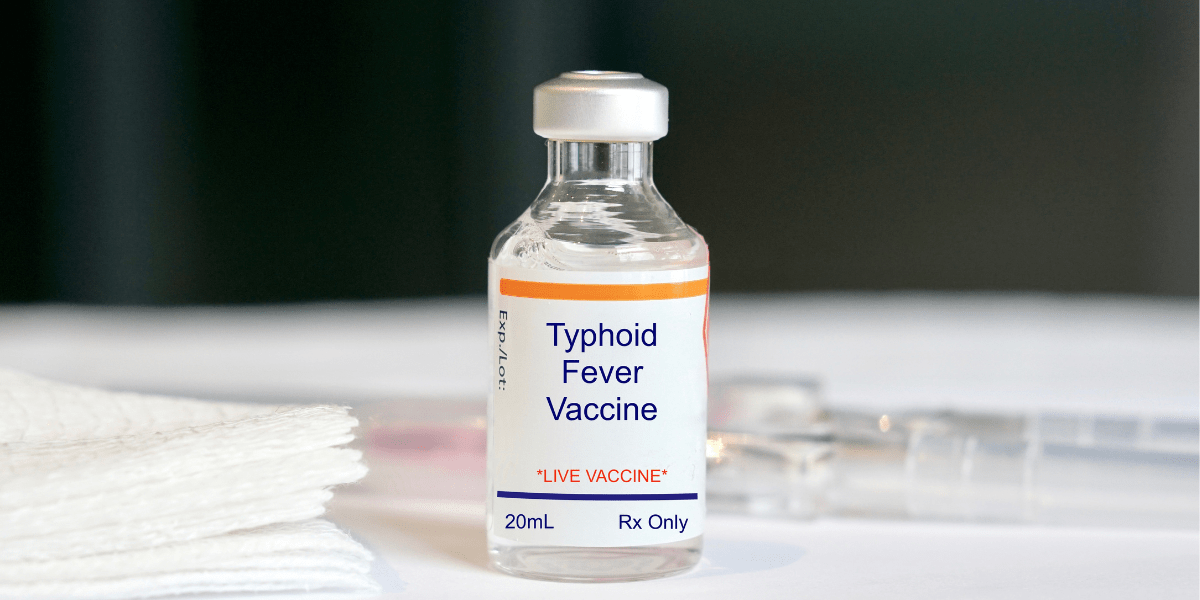
The most effective way to protect yourself against typhoid is vaccination before departure. The typhoid vaccine is a single-dose injection that provides protection for up to three years. It should be administered at least two weeks before travel to allow your immune system to build an adequate response.
Typhoid vaccination is particularly recommended if you are travelling to South Asia, Southeast Asia, Africa, or South America, eating at street food stalls or local markets, visiting rural areas with limited sanitation, or staying for extended periods.
At Regis Medical, the typhoid vaccine is part of our pre-travel vaccination and health consultation. During this consultation, our Doctors review your itinerary, assess your destination-specific risks, and recommend the appropriate vaccinations for your trip. Depending on where you are heading, this may include the typhoid vaccine alongside hepatitis B, Japanese encephalitis, yellow fever, or malaria prophylaxis.
Vaccination is not a substitute for food and water hygiene, but it provides a critical layer of protection when hygiene precautions fail. And they do fail. Even the most careful traveller cannot guarantee that every meal, every glass of water, and every piece of fruit has been prepared in perfectly sanitary conditions.
The Bottom Line
Food poisoning is miserable but self-limiting. Typhoid is dangerous and progressive. They can feel identical in the first 48 hours, and that similarity is exactly what makes typhoid so risky for travellers who assume they just ate something bad.
If your symptoms persist beyond three days, if your fever keeps climbing rather than breaking, or if you feel progressively worse rather than gradually better, do not wait it out. See a doctor and mention your travel history.
And if you haven't left yet, have a conversation with our Doctors about the typhoid vaccine before you go. A single dose taken two weeks before departure is far simpler than managing typhoid fever from a hospital bed abroad.
Vaccinate against typhoid fever when you travel
Patient-first, Holistic, Dedicated Healthcare
Medical Disclaimer & Limitation of Liability
The content provided in this post is strictly for informational and educational purposes. Just as we fiercely defend our right to publish general health information, we establish an uncompromising boundary: this material is never a substitute for personalised, professional medical advice, diagnosis, or treatment.
Reading this content does not establish a doctor-patient relationship. You possess the sovereign right and responsibility to manage your own health, which means you must consult your own qualified physician before making any medical decisions based on what you read here. We explicitly disclaim all medicolegal liability for any injury, loss, or risk incurred directly or indirectly from the misinterpretation, misuse, or out-of-context application of our online content. Your health is your responsibility; seek individual professional care.